The National Annual Holiday Service (RJV) is warning of new phishing attempts currently circulating via email and text message. This is the period when holiday pay is being paid out, and cybercriminals are keen to capitalise on this. The RJV urges people never to click on suspicious links and never to share personal details via email or text message.
Phishing via Doccle
This year, there has been a marked increase in fraudulent messages using the Doccle logo. The emails look credible and appear to come from the RJV. Anyone who checks the sender’s email address will immediately notice that the message originates from a different, suspicious address. In some cases, recipients are asked to log in via Itsme®. Fraudsters then try to get them to make a bank transfer or confirm a payment.
We also received this fake message more than 14,000 times last week via suspicious@safeonweb.be!
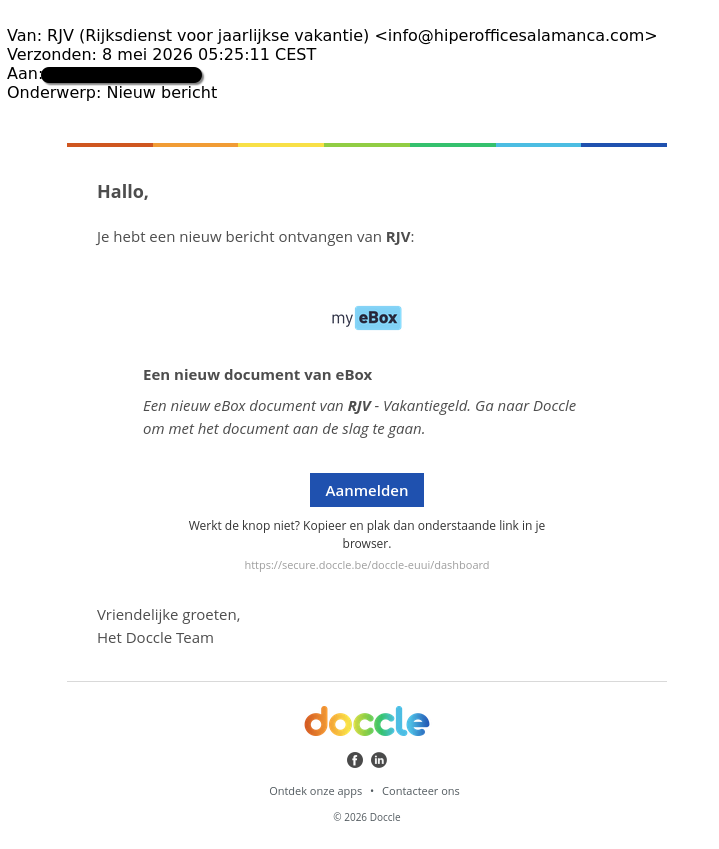
The RJV never asks for personal details via email or text message. The RJV also never sends messages asking you to urgently confirm an invoice or make a bank transfer. Members of the public are advised never to click on suspicious links and always to check the sender’s email address. By forwarding fraudulent emails to suspicious@safeonweb.be, the links can be blocked more quickly. The RJV recommends using only the online service mijnvakantierekening.be or the forms at www.rjv.fgov.be to share personal details.
Further information, specific examples and advice on cyber security are available at:
RJV – Beware of phishing attempts via text messages and emails circulating in the name of the RJV